

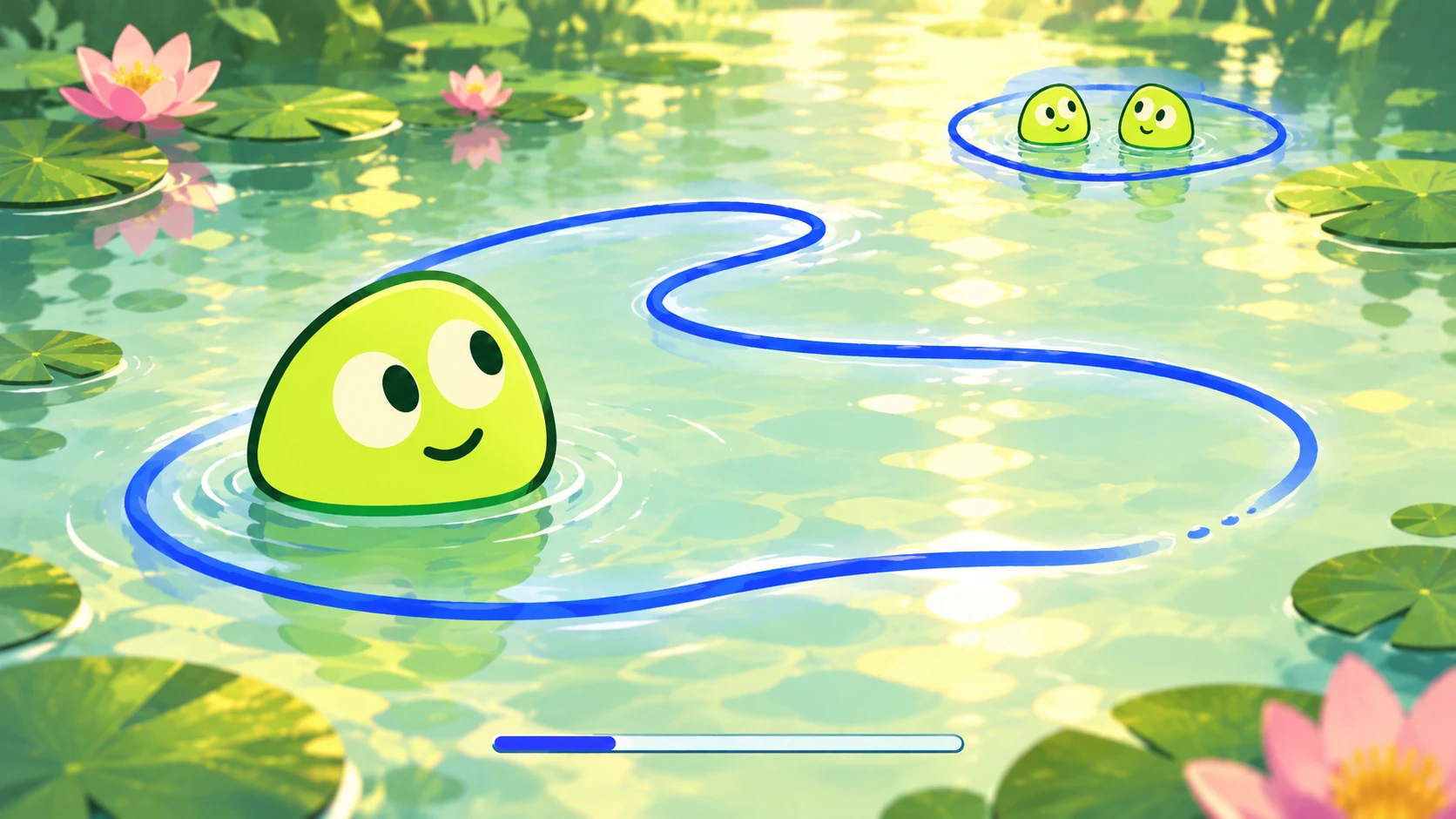
The ODDLOOP ink meter gives each drawing a useful limit. As your finger travels across the pond, the meter runs down. A long route can leave you without enough ink to finish the loop, even when the Churrs you wanted are still waiting inside it.
There is one important detail to understand first: ink belongs to the current stroke. You are not spending a single supply for the whole round. After you release or cancel that drawing, the next stroke begins with a fresh allowance.
Distance matters
Every extra bend makes the route longer. If you circle a group, follow a nearby Churr, swing around a Burr and then try to return to the start, you may have used much more ink than the original catch needed.
Choose the group before putting your finger down. Look for a route with some breathing room around the moving faces and enough clear water to close the shape. A broad, deliberate curve is often easier to finish than a string of small corrections.
Imagine two groups with a large gap between them. One huge loop might catch both, but it asks more of the stroke and gives nearby Burrs more chances to become part of it. Two separate catches can give you clearer decisions and fresh ink for the second drawing.
A slow stroke can dry
The meter also reflects the time available to complete your drawing. Holding a stroke open while you decide where to go can make the ink dry. Tracing slowly around a nearly finished loop is therefore a different risk from simply travelling too far.
You do not need frantic movements. Take a brief look before beginning, then draw with a steady purpose. Once you see the blue completion outline and the right group is inside, lift your finger to release the catch.
The useful rhythm is look, draw, close, release. The pause for planning comes before the stroke, rather than halfway through a line that is already using its allowance.
What to do when the ink runs out
If the game tells you that you are out of ink, lift your finger and try a smaller route. That failed stroke does not force you to wait for a round-wide tank to refill. Begin again with a clearer group or a shorter journey around the same one.
Watch for a repeated pattern in your attempts. If the meter empties while you are returning to the starting point, your route may be too wide. If it fades while you are hesitating beside a Churr, the decision may need to happen earlier.
Both problems are good reasons to simplify the next drawing. You can leave a distant face for another catch instead of stretching a nearly complete rescue beyond its useful shape.
Herding recharge is a separate limit
An open stroke can become a temporary herding line. After placing one, there is a short recharge before another can be placed. That message is separate from the ink allowance shown while you draw.
Loops remain ready during herding recharge. You can use your line to buy room, then make a catch while it holds. Waiting for another barrier when a safe rescue is already available can waste the opportunity you just created.
Some shop gear changes how much ink a stroke allows. You can learn the basic rhythm with the standard kit, so start by making your route shorter and your decision clearer. Good ink use is about finishing the drawing you intended, then giving the next catch its own fresh start.